 19 August 2021 · Vaccination
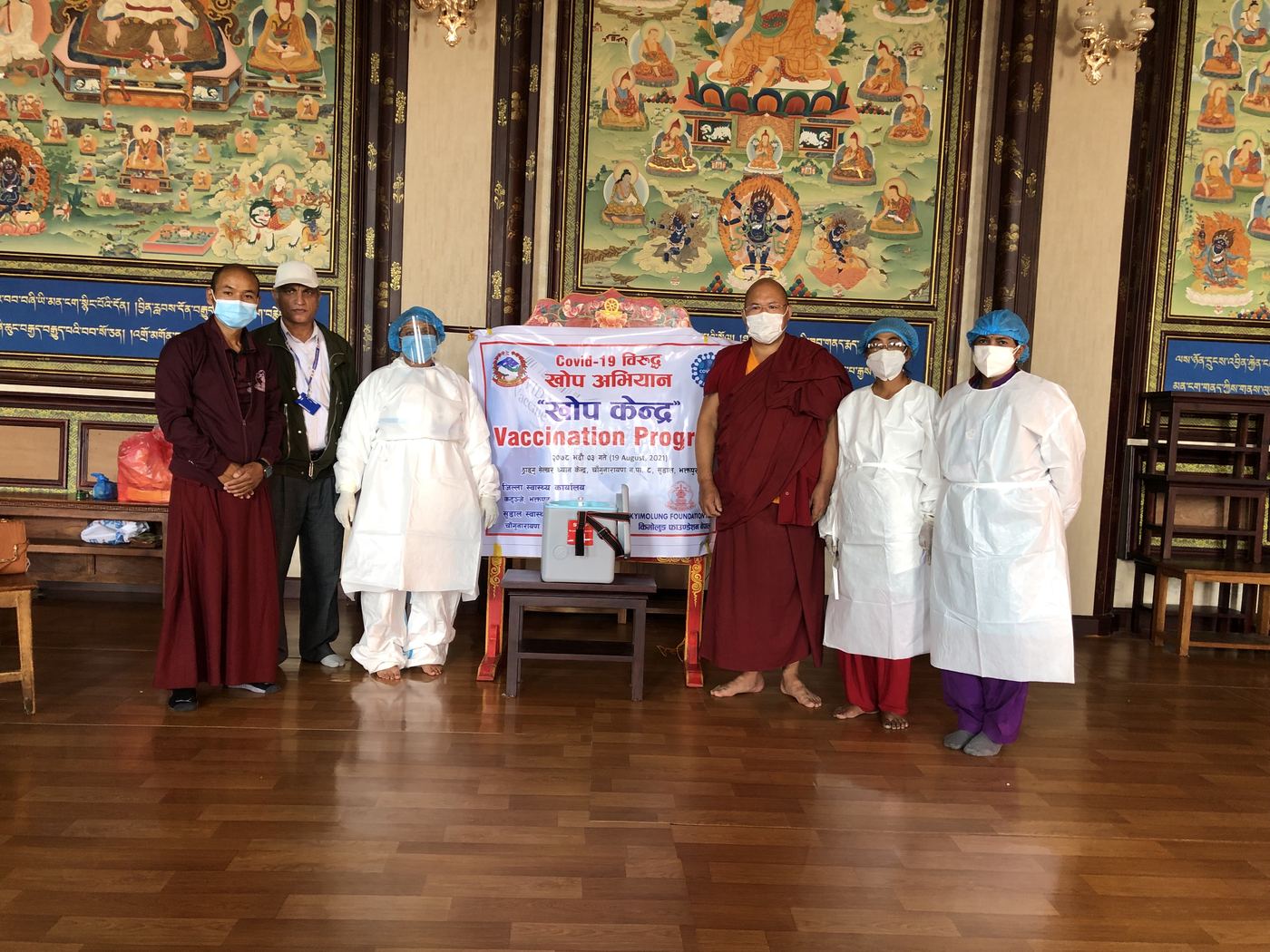
COVID-19 Vaccination at Thrangu Shelkar
A mobile vaccination campaign for more than one hundred practitioners in long-term retreat in Sudal, Bhaktapur, who could not leave to be vaccinated.
Read moreFood for families who lost their income, and oxygen and supplies for Chumnubri. See also our COVID-19 vaccination work.
The COVID-19 pandemic brought unprecedented challenges to communities across Nepal. During lockdowns and movement restrictions, many families who lived on daily wages, labour, small businesses and other informal work suddenly lost their income. For families already living in difficult circumstances, not being able to work meant not being able to put food on the table.
Kyimolung Foundation responded by working with local governments, schools, community organisations and humanitarian partners to bring food and other support to vulnerable families in Kavre, Kathmandu, Makawanpur, Surkhet and northern Gorkha, including some of the country’s most remote and marginalised communities. Our approach was simple: listen to local needs, work with local authorities, reach the families most in need, and give practical support with dignity.
| Where | Reached | Support |
|---|---|---|
| Namobuddha Municipality, Kavre | 800 families in all 11 wards | Rice 25 kg, lentils 5 kg, cooking oil 5 L and salt per family |
| Kathmandu and Pharping | More than 9,000 families | Weekly rice, lentils, wheat flour, dried soya and potatoes |
| Chepang community, Makawanpur | More than 2,100 people | Rice, lentils, cooking oil, tea, sugar and clothing |
| Raute community, Gurans Rural Municipality, Surkhet | About 450 people | Rice, dried chilli, salt, fresh radish and masks |
| Chumchet and Chhekampar, Tsum Valley, Gorkha | About 600 families | Rice, lentils, cooking oil, salt and dried chilli |
| Prok, Nubri, Gorkha | About 80 families | Wheat flour |
Namobuddha Municipality asked us for help for families facing severe hardship during the lockdown. Many families in its eleven wards depended on daily labour, and when businesses and workplaces closed to slow the spread of COVID-19, many were left with no income. Working with the municipality, and following the list of families it recommended, we distributed food packages to 800 vulnerable families across all eleven wards. Each package held 25 kg of rice, 5 kg of lentils (dal), 5 litres of cooking oil and two packets of salt. The support was made possible with help from Elevate Nepal.
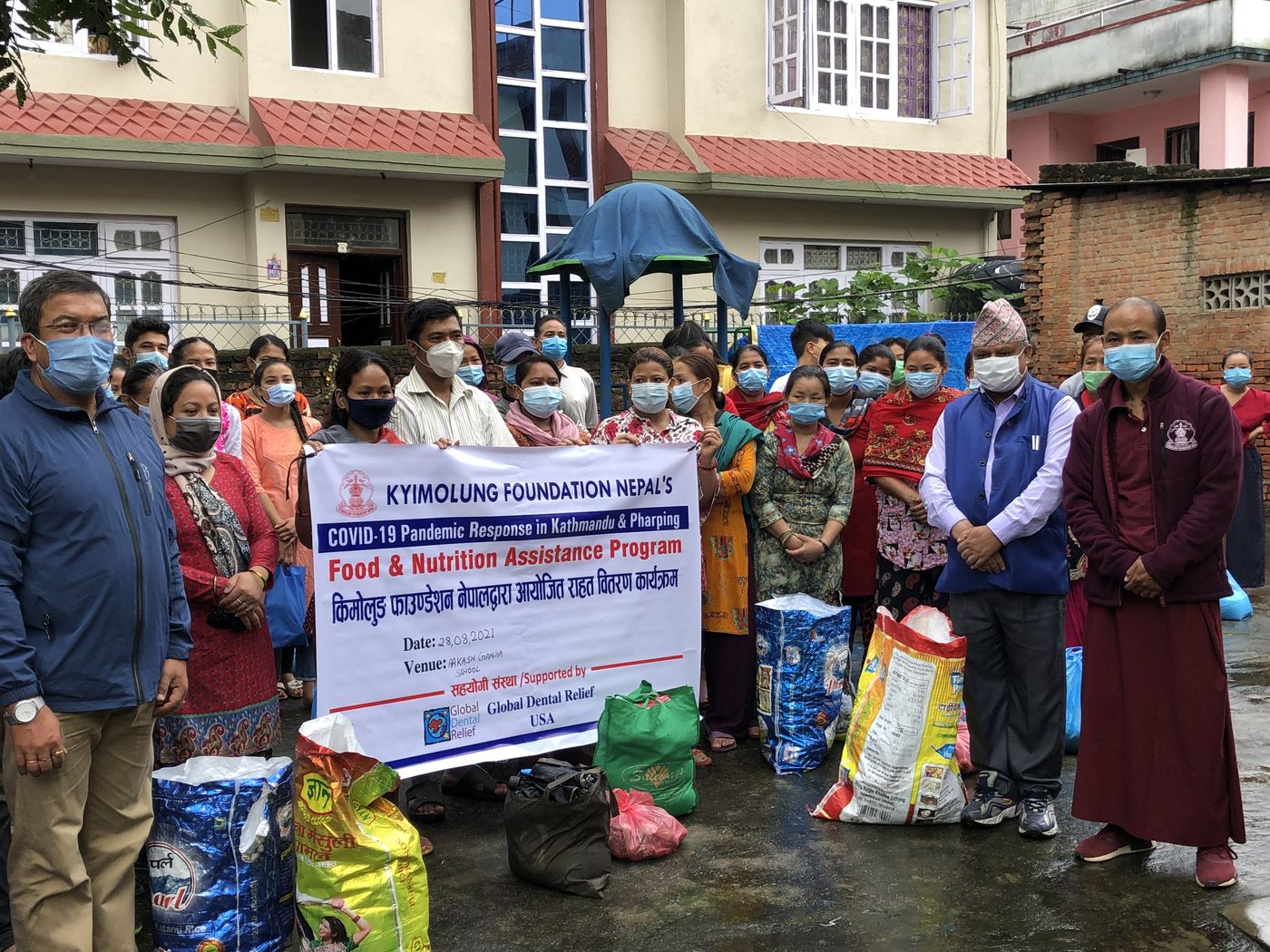
Before the pandemic, Global Dental Relief (GDR) regularly brought dental care to children in schools, monasteries and orphanages. When COVID-19 restrictions stopped its international volunteer doctors from travelling, and many students and their families faced serious food shortages, GDR decided to support families with food instead.
We worked with local ward offices and school management committees to organise the distribution, which took place under local government supervision so that it reached the identified families. The packages of rice, lentils, wheat flour, dried soya and potatoes were handed out every week, and more than 9,000 families received support.
The Chepang are one of Nepal’s historically marginalised and widely scattered communities, and during the pandemic many families struggled to get food and other necessities. We provided food packages of rice, lentils, cooking oil, tea and sugar, and clothing for families in need, reaching more than 2,100 people.
One of the most unique communities we reached was the Raute of Gurans Rural Municipality, Surkhet. Traditionally nomadic and Indigenous, the Raute are among the last nomadic peoples of Nepal; their population is small and their way of life is increasingly vulnerable.
On our first visit during the pandemic we met about 450 people; on a later visit there were fewer, a sign of the serious problems the community faced, including poor nutrition and health. Food was short and hygiene conditions were very difficult. We provided rice, dried red chilli, salt and fresh radish, gave the community a madal (a double-headed hand drum), and handed out masks. The visit was also a chance to understand the community’s living conditions, health concerns and nutrition needs.
In northern Gorkha the pandemic was even harder. Chumchet (ward 6) and Chhekampar (ward 7) of Chumnubri Rural Municipality were already isolated, and during the pandemic floods and landslides damaged the route into the Tsum Valley, cutting the villages off. Food and supplies that normally came up from the lower valleys and cities could not get through while paths and bridges were repaired.
With support from Günter Hoffmann and his family and Elevate Nepal, we provided food hampers of rice, lentils, cooking oil, salt and dried red chilli to about 600 families. Restoring the landslide-damaged route took a great deal of time and effort; trekkers entering the Tsum Valley today cross the cantilever bridge that helps reconnect these communities. We also gave wheat flour to about 80 families in Prok, ward 4, in Nubri.
The pandemic reminded us that a crisis does not affect everyone equally. For a family that lives on daily labour, a day without work can mean a day without food. For a remote mountain village, a landslide can mean weeks or months without supplies. For marginalised communities, existing hardships grow worse in a national emergency.
We could not solve every problem, but we could provide food, basic supplies, protection and a sense that communities were not forgotten. Our support was never about religion, gender, geography or background: humanitarian service belongs to everyone who needs it. The food hampers were simple, but they carried an important message.
You are not alone.
With Global Dental Relief
Alongside food relief, we responded to urgent medical needs in all seven wards of Chumnubri Rural Municipality. People in these remote mountain communities faced limited medical services, difficult transport and a great deal of fear about COVID-19. To strengthen the local response, we arranged and delivered essential medical and protective supplies to the municipality and local health facilities. They were formally handed over at the Rural Municipality Office in Sirdibas, Phillim, in the presence of the Chairperson, Vice-Chairperson, Chief Administrative Officer, department heads and other local representatives.
With roads and walking routes blocked or extremely difficult, supplies, above all oxygen equipment, were flown to remote communities by helicopter, because in these villages a delay could have serious consequences.
Equipment alone could not ease the fear many people felt. Some believed that catching COVID-19 meant little chance of recovery, especially with hospitals so far away. We worked with health-post staff and communities to offer basic counselling and reassurance: encouraging people to take preventive measures, watch for symptoms and seek care when needed, and explaining that patients who needed oxygen could be stabilised and referred to hospital. When serious cases were found, we helped with timely hospital referral.
Through emergency supplies, oxygen, counselling and referral together, we believe we helped save more than ten lives during the pandemic. We could not stop the pandemic, but we could help people get the support they needed when it mattered most.
Oxygen, PPE & Helicopter Deliveries
Also Part of Our COVID-19 Response
19 August 2021 · Vaccination
A mobile vaccination campaign for more than one hundred practitioners in long-term retreat in Sudal, Bhaktapur, who could not leave to be vaccinated.
Read more